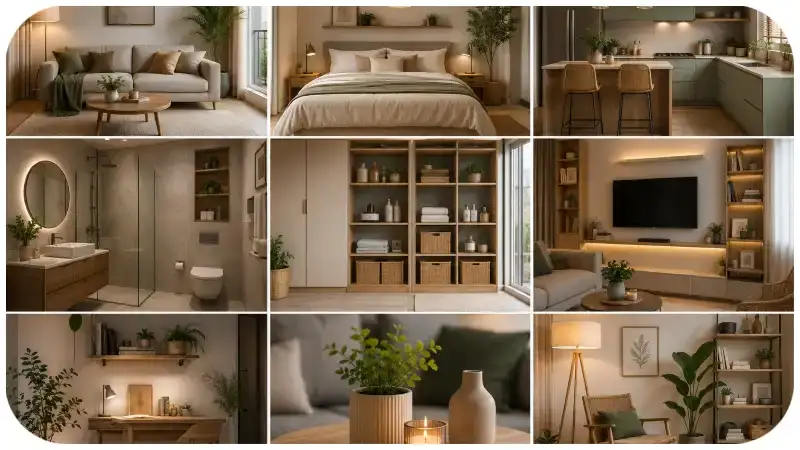
Home decor is not just a game of aesthetics. In real homes, one thing becomes very clear:
The feel of a space changes when design decisions are practical, not just decorative.
The HomeTrotters approach is based on this reality — it prioritizes what actually works in real living environments rather than what only looks good on display.
This guide is not theoretical inspiration. It reflects patterns and observations consistently seen in real small apartments, family homes, and urban living spaces.
1. Real Design Perspective: TheHomeTrotters Approach
In hands-on interior styling projects, one pattern appears repeatedly:
When people design their homes, they usually think about “look” first and “usage” later.
But in practice, the homes that feel the best do the opposite.
The core of The HomeTrotters approach is simple:
- Space should work first
- Furniture should support lifestyle
- Visual clarity is more important than clutter
This is not just design theory — it is a conclusion drawn from real usage behavior.
2. Small Spaces: A Real Problem in Most Homes
In small apartments, the most common issue is not actually “lack of space.”
The real problem is inefficient use of available space.
Based on real observation work, a few patterns appear consistently:
- People add unnecessary furniture
- Walkways get blocked
- Storage becomes visible instead of hidden
- The center of the room feels visually heavy
When a redesign approach is applied, the first step is always:
remove before adding anything new
Even this single step often makes a room feel noticeably lighter and more open.
3. Living Room: Real-Life Functional Design Logic
The living room is always treated as an interaction space, not a showroom.
In practical setups, one thing remains consistent:
When seating naturally supports conversation, the space immediately feels more usable.
Lighting follows a similar pattern. A single overhead light often makes a room feel flat and lifeless. When multiple light sources are introduced, the room gains depth and comfort.
This is not an aesthetic preference — it is directly connected to human comfort behavior.
4. Bedroom: Real Comfort vs Visual Styling
In bedroom design projects, a consistent pattern is observed:
Where clutter is reduced, rest quality feels better — even visually.
The reason is psychological. The brain relaxes more easily when visual input is simple and controlled.
That is why bedroom layouts always focus on:
- Keeping the bed as the central anchor
- Maintaining minimal surfaces
- Hiding storage visually as much as possible
This approach creates a noticeable difference, especially in small bedrooms.
5. Kitchen: Workflow First, Looks Second
In kitchen design, one of the strongest lessons is clear:
If the kitchen workflow is smooth, the space automatically feels better.
In real usage environments, effective kitchens usually have:
- Frequently used items placed within easy reach
- Storage divided in a logical and structured way
- Countertops kept clear for working space
Open shelving only works when maintenance is consistent. Otherwise, closed storage is the more practical and sustainable solution.
6. Bathroom: Maintenance-Friendly Design Approach
A practical truth about bathrooms is simple:
Designs that are easy to maintain always look better over time.
In real project experience, it is observed that:
- Clean surfaces instantly feel more premium
- Visual clutter quickly makes a space feel smaller
- Simple material palettes are easier to maintain and manage
Because of this, over-decoration is usually avoided in bathroom design.
7.Budget Homes: A Strategy That Actually Works
In budget-friendly interior design, the most effective strategy is:
Re-evaluate existing items before buying anything new.
In real scenarios, major improvements often come from rearrangement rather than new purchases.
Common results from this approach include:
- Better room flow after repositioning furniture
- A more cohesive look through color simplification
- Immediate visual clarity after removing unnecessary items
The key advantage is simple: visible improvement with zero cost.
8. Lighting: Real Impact We Consistently Observe
Underestimating lighting is one of the most common design mistakes.
In practical design experience:
- Warm lighting creates more comfortable living spaces
- Layered lighting adds depth and dimension
- Single-source lighting creates flat and dull environments
In many cases, changing lighting has a greater visual impact than changing furniture.
9. Sustainability: Long-Term Thinking in Real Homes
Sustainability is becoming increasingly important in modern homes.
At a practical level, it does not require complex changes. It simply involves:
- Choosing durable materials
- Selecting low-maintenance finishes
- Avoiding unnecessary replacements
These small decisions significantly improve long-term home quality and reduce waste.
10. Common Mistakes We Repeatedly See
In real design projects, some mistakes appear again and again:
- Overcrowded furniture layouts
- Ignoring lighting layers
- Mismatched scale (large furniture in small rooms)
- Too many conflicting styles in one space
Fixing these issues often improves the feel of a room immediately.
Final Thought: What Actually Makes a Home Work
From real interior design experience, one simple conclusion becomes clear:
A good home is not designed to impress — it is designed to function well every day.
The HomeTrotters approach is built on this principle:
- Less clutter
- Better flow
- Practical decisions
- Long-term usability
When these elements align, a space naturally feels better — without forcing decoration.