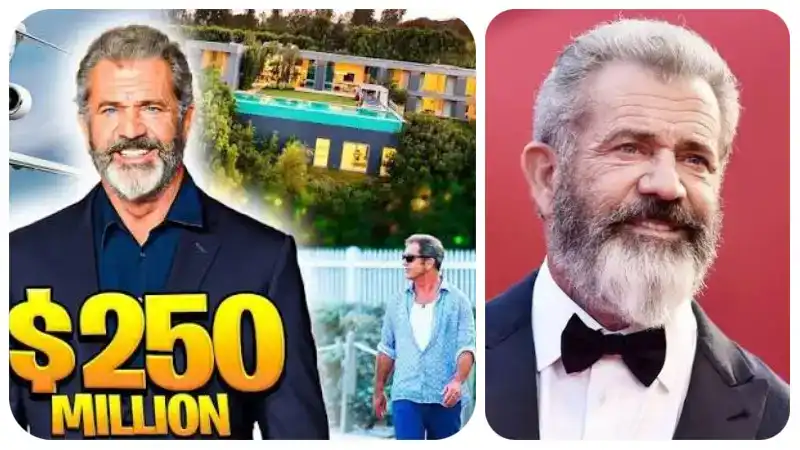
Mel Gibson is one of Hollywood’s most recognisable actor-directors, a figure whose career has moved through extraordinary success, controversy, reinvention and financial resilience. Best known for playing Max Rockatansky in Mad Max, Martin Riggs in Lethal Weapon and William Wallace in Braveheart, Gibson has also established himself as a producer and director behind some of the most commercially and culturally significant films of his generation.
As of 2026, Mel Gibson’s estimated net worth is approximately US$425 million, according to Celebrity Net Worth. That figure is an estimate rather than a publicly audited statement of his personal finances, so it should be treated as an informed approximation rather than a confirmed balance sheet.
His wealth is particularly interesting because it did not come solely from acting salaries. Gibson made major financial gains by taking producer and director roles, retaining ownership interests and, most famously, taking substantial financial risks on The Passion of the Christ (2004). That film became a worldwide commercial phenomenon, grossing more than $610 million against a reported $30 million budget.
Early Life and Family Background
Mel Columcille Gerard Gibson was born on 3 January 1956 in Peekskill, New York, USA. He was the sixth of 11 children born to Hutton Gibson and Anne Patricia Gibson, who had Irish ancestry. Although born in America, Gibson’s childhood and professional identity became strongly associated with Australia after his family moved there when he was 12.
The move proved pivotal. Gibson grew up in New South Wales and attended Catholic schools, including St Leo’s Catholic College and later Asquith Boys High School. His Australian upbringing eventually became an important part of his public identity, particularly during the early stage of his acting career.
Gibson has also maintained a connection with his Irish heritage. His mother was born in Ireland, while his father was of Irish descent. That background helped shape the cultural influences surrounding his childhood and later appeared in aspects of his public life.
Interestingly, acting was not initially an obvious career choice. Gibson reportedly considered becoming a chef or journalist before his sister encouraged him to apply to Sydney’s National Institute of Dramatic Art.
That decision changed the direction of his life.
Education and Acting Training
Gibson studied at the National Institute of Dramatic Art (NIDA) in Sydney, one of Australia’s most respected performing-arts institutions. He enrolled after auditioning despite having little previous professional acting experience.
During his time at NIDA, Gibson performed in stage productions and worked alongside future Australian acting stars, including Judy Davis and Geoffrey Rush. His classical training gave him experience with demanding theatrical material, which later helped distinguish him from many actors who entered Hollywood primarily through television.
His NIDA years also provided the foundation for his first professional performances. He appeared in a production of Romeo and Juliet and subsequently joined the Southern Australian Theatre Company, where he took on roles in classical plays such as Oedipus and Henry IV.
In other words, Gibson’s path to international stardom began not with Hollywood but with Australian theatre.
Career Beginnings: From Australian Actor to Mad Max
Gibson’s first film appearance came in the 1977 Australian film Summer City. At the time, he was an inexperienced actor at the beginning of his professional career.
His breakthrough arrived soon afterwards when director George Miller cast him as Max Rockatansky in Mad Max (1979).
The low-budget Australian action film became an international success and introduced audiences to a distinctive new screen presence. Gibson combined physical intensity with a relatively understated acting style, creating a character who was both vulnerable and formidable.
The success of Mad Max led to two sequels: Mad Max 2 (1981), also known internationally as The Road Warrior, and Mad Max Beyond Thunderdome (1985). Together, the films transformed Gibson into an international action star.
However, his career was already expanding beyond Australia.
In 1981, Gibson starred in Peter Weir’s Gallipoli, a World War I drama that earned him an Australian Film Institute Best Actor award.
The role was important because it demonstrated that Gibson could handle emotionally complex dramatic material as well as action.
The Lethal Weapon Era and Hollywood Stardom
Gibson’s next major transformation came with Lethal Weapon in 1987.
Playing Los Angeles police officer Martin Riggs opposite Danny Glover’s Roger Murtaugh, Gibson helped create one of the defining buddy-cop characters of the late 20th century. Riggs was reckless, funny and emotionally damaged, allowing Gibson to combine comedy, action and drama within the same performance.
The film became a franchise, followed by:
- Lethal Weapon 2 (1989)
- Lethal Weapon 3 (1992)
- Lethal Weapon 4 (1998)
The series established Gibson as one of the world’s highest-profile action stars. It also gave him substantial commercial leverage as his career progressed.
By the early 1990s, however, Gibson was increasingly interested in working behind the camera.
Becoming a Director and Producer
Gibson directed his first feature, The Man Without a Face, in 1993. He also starred in the film, demonstrating that he was interested in controlling more than simply his on-screen performance.
His major breakthrough as a filmmaker came two years later with Braveheart (1995).
Gibson directed, produced and starred as William Wallace, the Scottish warrior at the centre of the historical epic. The film became a major box-office success, earning more than $213 million worldwide according to Box Office Mojo.
The film also changed Gibson’s professional status.
He was no longer simply a successful actor who occasionally directed. He had become an award-winning filmmaker.
At the 1996 Academy Awards, Braveheart received 10 nominations and won five Oscars, including Best Picture and Best Director for Gibson.
He also won the Golden Globe for Best Director for the film.
These achievements remain among the most important milestones of his career.
Major Financial Turning Point: The Passion of the Christ
Although Braveheart cemented Gibson’s artistic reputation, The Passion of the Christ dramatically altered the financial story behind his career.
Released in 2004, the religious drama portrayed the final hours of Jesus Christ. Gibson directed, co-wrote and produced the film, which was made largely outside the traditional Hollywood studio system.
The project was highly controversial because of its extreme violence, religious subject matter and debates surrounding its interpretation of biblical events. Nevertheless, audiences responded strongly.
Box Office Mojo records a worldwide gross of approximately $610.1 million, including more than $370.7 million in the United States and Canada, from a reported $30 million production budget.
The financial result was extraordinary.
Forbes ranked Gibson first in its 2004 Celebrity 100, estimating that he earned $210 million during the relevant measurement period, largely reflecting the enormous financial impact of The Passion of the Christ. Forbes also noted that the film had generated more than $600 million at the box office.
This helps explain why estimates of Gibson’s fortune cannot be understood simply by adding up acting salaries. His financial strategy included ownership, producing and participation in film revenues.
Apocalypto and Continued Directing Ambitions
Gibson followed The Passion of the Christ with Apocalypto in 2006.
Set in Mesoamerica shortly before European contact, the film was notable for its use of the Yucatec Maya language and its intense visual storytelling. Once again, Gibson chose a subject and production approach that differed considerably from conventional Hollywood filmmaking.
The project reinforced his reputation as a filmmaker willing to take substantial creative risks.
However, his career subsequently entered a difficult period.
Controversies and Career Setbacks
Gibson’s public image suffered severely during the 2000s and early 2010s following a series of highly publicised controversies, including offensive remarks and allegations surrounding his personal conduct. These events had significant consequences for his professional standing.
Biography.com notes that his status as a bankable Hollywood star suffered following controversial comments and domestic-abuse allegations, although he later returned to directing.
This period is essential when considering Gibson’s career because his story is not simply one of uninterrupted success.
His professional trajectory demonstrates how quickly public reputation can affect an established actor’s access to major studio projects. At the same time, it also shows the commercial value of an established body of work: despite the setbacks, Gibson remained financially powerful and eventually returned to high-profile filmmaking.
Hacksaw Ridge and a Directorial Comeback
Gibson’s major comeback behind the camera came with 2016’s Hacksaw Ridge.
The Second World War drama tells the story of Desmond Doss, a conscientious objector who served as a combat medic and refused to carry a weapon.
The film received six Academy Award nominations. Gibson earned his second Oscar nomination for directing, more than two decades after his victory for Braveheart. The Academy specifically records Hacksaw Ridge as his second nomination in the directing category.
The film was significant beyond its awards performance. It demonstrated that Gibson could once again attract serious critical attention as a director after years of professional difficulty.
Recent Career and Flight Risk
Gibson has continued acting and directing into his later years.
In 2025, he directed Flight Risk, a thriller starring Mark Wahlberg. The project marked another return to the director’s chair and demonstrated that Gibson remained active in mainstream cinema.
In 2026, he also discussed plans for Lethal Weapon 5. Following the death of original director Richard Donner in 2021, Gibson said he had taken over directing responsibilities for the long-awaited sequel. The project remains subject to industry delays, however.
This latest phase of his career is notable because Gibson has increasingly operated as an actor-director rather than relying exclusively on traditional leading-man roles.
Mel Gibson Net Worth: How Much Is He Worth in 2026?
So, what is Mel Gibson’s net worth?
The most widely cited current estimate is US$425 million.
Celebrity Net Worth lists Gibson’s wealth at $425 million and updated its estimate in March 2026. Other entertainment publications, including Parade, have repeated the same estimate.
However, it is important to understand what this number means.
There is no publicly available audited document showing Gibson’s complete personal balance sheet. Celebrity net-worth figures are therefore estimates based on publicly reported earnings, assets, investments, property and business interests.
How Gibson Built His Wealth
His estimated fortune has several sources:
1. Acting
Gibson earned substantial salaries from major franchises including Mad Max and Lethal Weapon, alongside films such as Ransom, Conspiracy Theory, What Women Want, Maverick and Signs.
2. Directing and producing
His decision to become a producer and director allowed him to participate in film economics beyond a conventional acting fee.
3. The Passion of the Christ
This was arguably the biggest financial turning point of his career. Gibson reportedly invested heavily in the project and benefited from its extraordinary commercial performance. The exact amount he personally earned remains disputed across published estimates, so claims of a specific payday should not be treated as independently verified fact.
4. Production ownership
Gibson’s involvement with Icon Productions helped him structure projects around ownership and production participation rather than relying entirely on studio employment.
5. Property and investments
Real estate and other investments have also contributed to his wealth, although the precise value of his current holdings is not publicly established.
The Famous Divorce Settlement
Gibson’s financial history also includes one of Hollywood’s most expensive celebrity divorces.
He married Robyn Moore in 1980, and the couple eventually had seven children. They separated in 2006, while the divorce process took several years to complete. The marriage was formally dissolved in 2011/2012.
Published estimates have put the settlement at approximately $425 million, although the precise financial terms were not fully made public. Celebrity Net Worth has described it as one of the most expensive celebrity divorce settlements.
The scale of the settlement provides useful context for understanding Gibson’s finances. His wealth had already reached extraordinary levels before the divorce, and his subsequent estimated $425 million fortune indicates the extent to which he remained financially successful after the settlement.
Personal Life and Family
Gibson has nine children from three relationships.
His first marriage to Robyn Moore produced seven children. He later had a daughter, Lucia, with musician Oksana Grigorieva. Gibson’s youngest child, Lars, was born in 2017 to screenwriter Rosalind Ross.
Gibson and Ross began their relationship in 2014 and separated in 2025, according to recent reporting.
Some of Gibson’s children have entered creative professions. His son Milo, for example, became an actor after previously working as an electrician.
Despite his enormous public profile, Gibson has generally kept much of his family life away from the entertainment spotlight.
Awards and Recognition
Gibson’s major awards include:
- Academy Award for Best Director – Braveheart (1995)
- Academy Award for Best Picture – Braveheart (as producer)
- Golden Globe Award for Best Director – Braveheart (1996)
- Academy Award nominations for Best Director – Braveheart and Hacksaw Ridge
- Multiple Australian film-industry recognitions, including an Australian Film Institute Best Actor award for Gallipoli
The most impressive aspect of this record is the range. Gibson has been recognised both as a performer and as a filmmaker.
Interesting Facts About Mel Gibson
He was born in America but raised largely in Australia
Gibson’s American birthplace sometimes causes confusion about his identity. His formative years were spent in Australia, where he trained as an actor and began his professional career.
His breakthrough came from a relatively low-budget film
Mad Max was not originally conceived as a conventional Hollywood blockbuster. Its success helped demonstrate the international commercial potential of Australian genre filmmaking.
He won Oscars as both director and producer
Braveheart gave Gibson one of the rarest achievements in cinema: winning the Academy Award for Best Director while also receiving the Best Picture Oscar as a producer.
The Passion of the Christ was a major independent gamble
Rather than relying entirely on a major studio, Gibson took considerable financial and creative risk with the film. Its commercial performance became one of the most remarkable success stories in modern independent cinema.
He returned to Oscar-nominated directing after a long absence
His Best Director nomination for Hacksaw Ridge in 2017 demonstrated that his filmmaking career had not ended despite the serious controversies of the previous decade.
Legacy and Influence
Mel Gibson’s influence on cinema is complicated but substantial.
As an actor, he helped define the modern action hero. Max Rockatansky and Martin Riggs were not simply physically capable characters; both carried emotional vulnerability and personal trauma. That combination influenced the tone of later action films.
As a director, Gibson demonstrated that commercially successful stars could use their influence to finance unconventional projects. Braveheart, The Passion of the Christ and Apocalypto all differed considerably in subject, language, setting and production style.
His greatest business lesson may be the importance of ownership and creative control.
Rather than remaining dependent on acting fees, Gibson increasingly positioned himself as a producer and filmmaker with a financial stake in his projects. The extraordinary success of The Passion of the Christ showed how powerful that model could become when a film connects with a large audience.
At the same time, his career illustrates the limits of commercial success. Reputation matters enormously in entertainment, and Gibson’s controversies caused serious professional consequences despite his previous achievements.
That tension is central to understanding his legacy.
Conclusion
Mel Gibson’s story is far more complicated than the headline figure attached to his fortune.
Born in New York in 1956 and raised largely in Australia, he trained at NIDA before becoming an international star through Mad Max. Lethal Weapon transformed him into one of Hollywood’s biggest action stars, while Braveheart established him as an Oscar-winning director and producer.
Then came The Passion of the Christ, a film that not only became a global box-office phenomenon but also fundamentally changed the financial scale of Gibson’s career.
His later controversies damaged his reputation and reduced his presence in mainstream Hollywood for a period. Nevertheless, Hacksaw Ridge demonstrated that he could return to serious filmmaking, earning another Academy Award nomination for directing.
Today, published estimates place Mel Gibson’s net worth at around $425 million, although the precise figure cannot be independently verified because his complete assets, investments and liabilities are private.
Ultimately, Gibson’s significance lies in the unusual combination of acting stardom, directing ambition, financial risk-taking and cultural influence. Few Hollywood careers have travelled such a dramatic path — from Australian theatre and Mad Max to Oscar-winning filmmaking, unprecedented independent-film profits, major personal controversies and a later return to the director’s chair.
For more information, visit our site daily.